
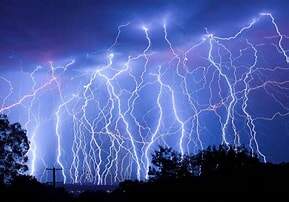
Lightning can heat the air to 50,000° F.
“How hot is lightning?” is a bit of a trick question. Lightning itself doesn’t have a temperature, because it’s just the movement of electrical charges in the atmosphere. You can think of it as one big spark of electricity that happens when positive and negative charges build up within a cloud, between clouds, or between a cloud and the ground. But that doesn’t stop lightning from heating up whatever it passes through — in this case, air. Air is a poor conductor of electricity, so it heats up tremendously when lightning strikes. In fact, lightning can heat the air to 50,000°F, which is five times hotter than the surface of the sun.
 Lightning can indeed strike the same spot twice, and often does. Just ask Chicago’s Willis Tower, which is struck more frequently than any other building in the U.S. — 250 times between 2015 and 2020.
 Suffice to say that the air stays extremely hot near Venezuela’s Lake Maracaibo, home of what’s been dubbed the “everlasting lightning storm.” Known locally as Relampago del Catatumbo, or the Lightning of Catatumbo (named for a nearby river that enters into the lake), the phenomenon has been recognized by the Guinness Book of World Records as involving the most lightning strikes (250 per square kilometer) of any spot in the world. Ten-hour lightning storms occur some 150 times per annum, and lightning itself can be seen up to 300 nights every year.
Numbers Don’t Lie
♦ Speed of a lightning bolt 270,000 mph
♦ Lightning strikes per second across the world 44
♦ Times Virginia park ranger Roy Sullivan was struck by lightning, a world record 7
♦ Width of a lightning bolt 2-3 cm
♦ Florida experiences the most lightning per square mile of any U.S. state.
 People used to think that ringing the church bells repelled lightning. There’s a good reason why some church bells still have the words “fulgura frango” inscribed on them. The phrase, Latin for “I break up lightning,” is evidence of a superstition dating back to the medieval era: that ringing church bells prevented lightning strikes. You might be able to guess how the superstition was proved to be just that — a great many bell-ringers were struck by lightning — but the belief persisted until the late 18th century. It’s far from the only way people once tried to repel lightning, of course. Europeans used to plant Sempervivum tectorum, also called houseleek or hens and chicks, on the roofs of houses and churches in the belief that it somehow prevented lightning and fire.
Leave a Reply