
 In many cases, aches and pains can be a reflection of your daily routines. Habits like sitting at a desk all day, looking down at your phone or even straining to pick your socks up off the floor can lead to a body that feels creaky, tight and sore.
We asked physical therapists to share the exercises they wish everyone incorporated into their fitness routines. Here are six that came up again and again.
1. Standing on one leg
 This simple exercise can “strengthen all the muscles in your foot, your ankle, your knee, your thigh,” Dr. Marko said. It also helps to build stability — not only in your legs, but also in your hips, pelvis and lower back.
If standing on one leg is challenging for you, lightly rest your hand on a chair, a wall or a countertop until you feel stable enough to let go. If the exercise feels easy, close your eyes.
Stand on each leg for at least 30 seconds every day.
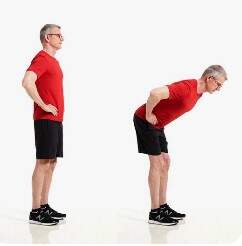 2. Hip hinges
Regularly practicing hip hinges can also strengthen your glutes and hamstrings.
To do a hip hinge, send your hips backward while bringing your chest forward. Keep your back straight, your shoulders pulled slightly back, your abdominal muscles pulled toward your bellybutton and your knees softly bent.
Practice this movement daily, doing two sets of 15 hinges.
3. Sit-to-stands
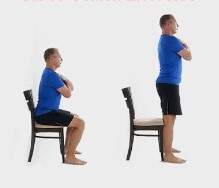 “Sit-to-stand” exercises will pay off by strengthening your quads, glutes, hamstrings, calves and core muscles, and improve your ability to to do lunges and squats, the experts said.
To do a sit-to-stand, lower yourself into a chair and stand back up in a slow, controlled way. If this feels challenging, practice it several times a day until it feels easier.
If it already feels easy, lower your body even more slowly and just barely tap your butt to the seat before slowly standing up again. The lower the surface, the more challenging it will be. Do two sets of 20 repetitions several times a week. For more of a challenge, do it while holding weights or a kettlebell.
4. Dead bugs with diaphragmatic breathing
 Many people feel the effects of sitting for long periods in their neck, shoulders or back, but the problem often begins in their innermost core muscles, said Carrie Pagliano, a physical therapist in Arlington, Virginia. “When your core is weak, your neck and shoulders often compensate to keep you upright.”
Physical therapists recommended doing the dead bug exercise while practicing diaphragmatic breathing to build core strength at the deepest level.
To do a dead bug, lie on your back and raise your legs at a 90-degree angle, then raise your arms straight toward the ceiling. With your spine pressed into the floor, slowly straighten and lower your left leg while also lowering your right arm, until both are fully extended. Return to the starting position, then repeat with the opposite sides.
While extending, slowly exhale through your mouth to contract your deep core. While returning to the starting position, inhale and feel your belly expand. Do two sets of eight exercises a few times a week.
 5. Wall push-ups
Push-ups allow you to practice lifting your body weight, which is essential for staying independent as you age and getting up if you fall, Dr. Nordengren said. They primarily strengthen the chest, shoulders, arms and core.
Start in a plank position, with your back flat and your feet pressed into the floor. Next, engage your core and slightly tuck your tailbone underneath you to prevent your back from arching. Bend your elbows into a 45-degree angle, while slowly lowering your chest, then push yourself back up. Imagine that you are pushing the floor away, Dr. Nordengren said, and be sure to reach your arms long at the top. Do two sets of 10 reps twice a week.
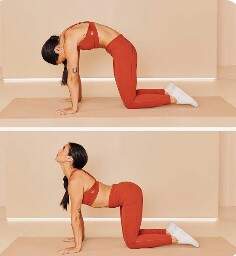 6. Cat-cows
To counter the effects of sitting or standing for long periods of time, many physical therapists recommended the cat-cow stretch, in which you alternate between arching and curving your back while on all fours. Take a few deep breaths in each position to feel a deeper stretch. This classic stretch can help relieve stiffness in your spine, shoulders and neck and improve your mobility.
When you’re in an all-fours position, you can limber up other body parts, too, Dr. Ferriere said. Try reaching forward with each arm or stretching each leg out behind you and doing a few hip circles.
Leave a Reply