
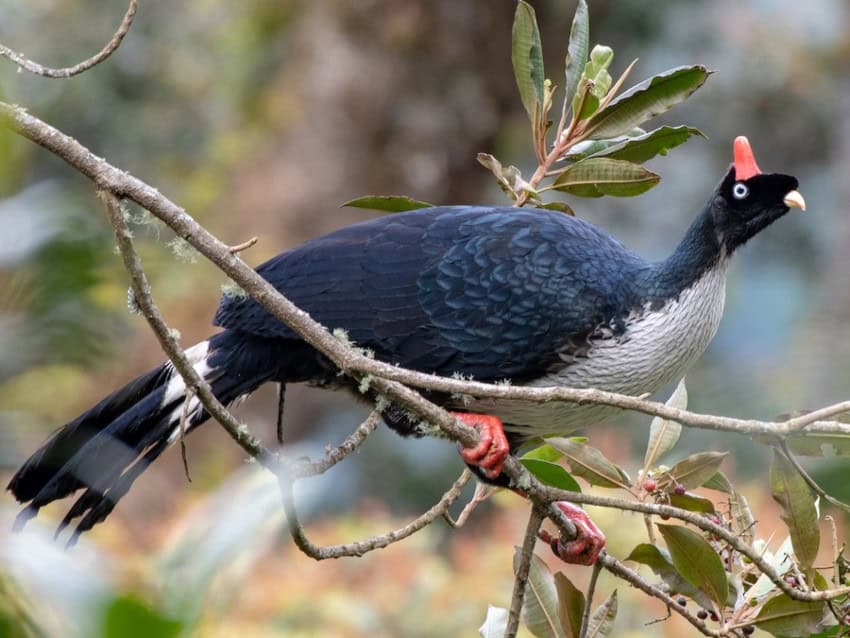
 Sightings of the horned guan are rare due to the species’ limited numbers and limited geographic range. (eBird)
An odd discovery
As the story goes, sometime during the 1840s, a man named Don Joaquín Quiñones collected the body of a strange bird from the forested slopes of Volcán de Fuego in Guatemala. Quiñones is said to have passed it to Edward Smith-Stanley, the 13th Earl of Derby, an enthusiastic naturalist and a sponsor of the British Museum. Smith-Stanley, in turn, loaned the specimen to George Robert Gray, head of the British Museum’s ornithological section, who recognized it (inaccurately, as it would turn out) as a new member of the group of birds known as guans. These chicken-sized, social, tree-living birds were found from Mexico to northern South America, with a few species having established themselves on Caribbean islands.
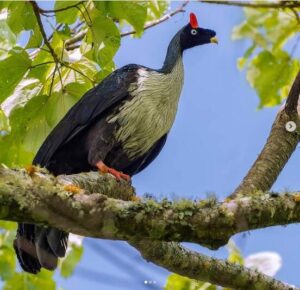
All guans are strange-looking birds, and this one was particularly ridiculous. It had a dark back, white chest and, most notably, a striking red, fleshy “horn” on its forehead.
Gray listed the discovery in his 1844 publication “The Genera of Birds.” He named it Oreophasis derbianus, honoring both its mountain home and the Earl of Derby, though colloquially it would come to be known as the horned guan.
Spotting the elusive horned guan
 The horned guan is only found in Guatemala and in the Mexican state of Chiapas. (Cephas/Wikimedia Commons)
The horned guan is a rare bird, existing in meager colonies limited to forests on the mountain slopes of Chiapas and southern Guatemala. This combination of a small population and remote forest habitat makes the horned guan a difficult bird to see.
Even if a tourist travels to these forests, sighting the bird is far from certain. It requires a knowledgeable local guide and a trek that begins before daybreak.
The field station at El Triunfo Biosphere Reserve offers a good chance of spotting guans. The odds improve in the mating season when the birds become notably noisy.
It is also worth remembering that these forests are alive with colorful and exciting birds — seeing a guan should be considered a bonus to any trip, not the sole reason for it.
 What we know about the horned guan
After nearly a century, we know a fair bit about the horned guan. They feed on a variety of fruit, flowers and leaves gathered from the forest canopy, but might also come down to the ground in search of food. In fact, although they are largely regarded as solitary creatures, they do gather in numbers while feasting.
Details of their nests remained a mystery until the 1980s, but we now know they use leaves and roots to build a simple and relatively small structure in the lower to upper forest canopy.
Mating and courtship rituals
The most energetic period of the mating season stretches from January to March and, unlike many birds, the males use this time to move between several females. Mating involves fanciful displays including wing-beating, neck-stretching and tail-spreading.
What was unexpected was the role dust-bathing plays in courtship rituals. The male selects a dust bowl and then calls to attract a female. They will stay together in the dust for up to 30 minutes, a ritual that cleans their plumage and eliminates parasites before they start nesting.
There is no precise record of the division of labor between parents during incubation and chick-rearing.
The lifespan of the horned guan
The bird’s exact lifespan in the wild is unknown, as is the juvenile mortality rate. Like so many creatures living in Central American forests, it is declining in numbers as its habitat shrinks.
The International Union for Conservation of Nature’s Red List of Threatened Species estimates the horned guan population to be between 600 and 1,700 mature individuals. The bird was also designated endangered in 2000.
There is some good news, however. Efforts to stop illegal poaching have been successful, and the tropical bird has been protected across nature reserves in Chiapas and Guatemala.
Leave a Reply