
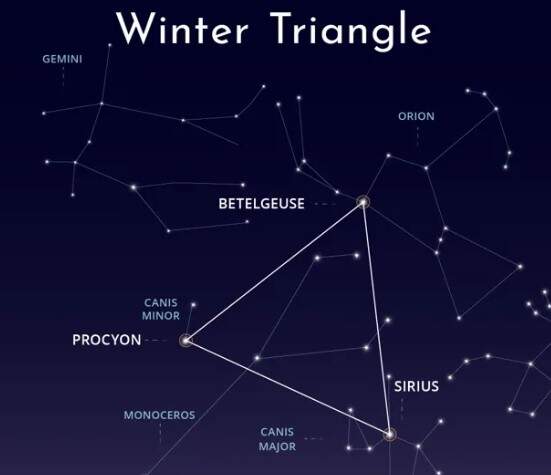
See if you can spot three bright stars making up a shape known as the Winter Triangle. Although it’s not an official constellation, it is a familiar pattern known as an asterism.
Throughout the month at around 20:00, look southeast to spot the brightest star in the night sky, Sirius, close to the horizon in the constellation of Canis Major. Further up, you’ll spot an orange-red coloured star called Betelgeuse marking one of the shoulders of Orion the Hunter. And completing the third corner of the triangle is the star Procyon in Canis Major. In Greek mythology, Canis Major and Canis Minor were Orion’s hunting dogs.
All three should appear visible to the naked eye, even in moderately light-polluted skies. That’s because this trio of stars are amongst the ten brightest stars in the night sky – with Procyon at number seven and Betelgeuse rounding up the top ten! Due to Sirius’ brightness and with it usually being positioned low in the sky, it’s starlight is refracted by the Earth’s atmosphere. This makes it appear to twinkle rapidly with flashes of color including red, blue, and green!
 The Full Moon on 3 January is called the Wolf Moon, named after active wolves during the early parts of the year. Some believe wolves howl more in January to find pack members, mark territory, and coordinate hunts. Celtic names for this Full Moon include Stay Home Moon and Quiet Moon.
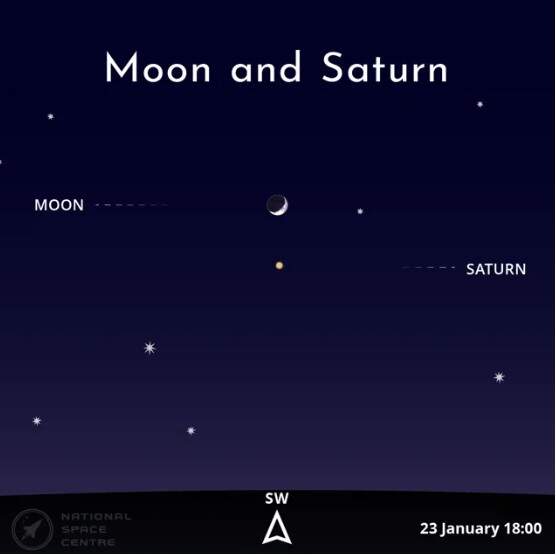
On the evening of 23 January, around 18:00, look southwest to spot the waxing crescent moon sitting above Saturn. You’ll be able to see both without a telescope. and they’ll move westwards As the night unfolds they’ll move westward, setting by 21:00.
Leave a Reply