
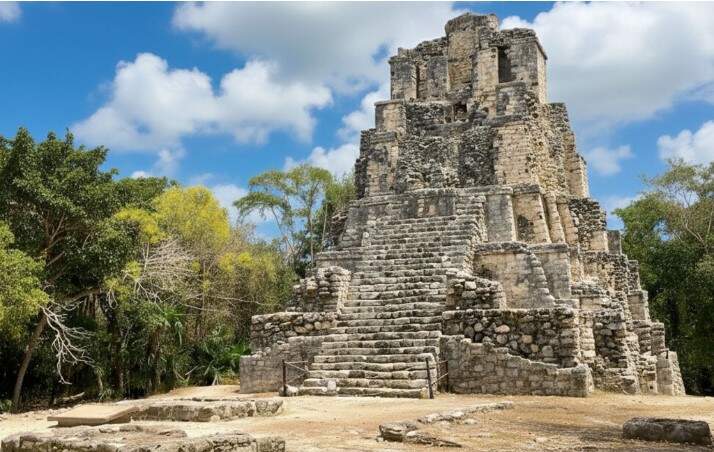
Photo: Carlos Rosado van der Gracht / Yucatán Magazine
The Mexican archaeological site of Muyil, also known as Chunyaxché, has reopened to the public after a 2024 closure for restoration. During restoration work at Muyil, archaeologists uncovered a temazcal and a collapsed vault that contained a ceramic vessel adorned with the face of a god wearing a headdress, diadem, and ear ornaments, and displaying a stern expression. Also discovered was a complete necklace, with a pectoral made of carved seashells and jade.
 Muyil is in the Sian Ka’an Biosphere, a protected area to the south of the Riviera Maya known for its abundant flora and fauna. The mature semi-deciduous jungle within the Muyil archaeological site supports a particularly dense amount of birds, including species such as the Black-headed Trogon, Buff-bellied Hummingbird, Yucatán Woodpecker, Yucatán Vireo, Yucatán Jay, Yucatán Flycatcher, and Green Jay. The area is also rich with many species of woodcreepers, woodpeckers, flycatchers, and migrant warblers. Beyond the birds, visitors also often encounter howler monkeys and spider monkeys in the canopy.
Aside from its surroundings, Muyil is of particular interest because, unlike virtually all archaeological sites near the coast of Quintana Roo, its foundation dates to the preclassic, roughly 350 BCE, though some evidence suggests the city began to take form as early as 500 BCE. Given the early construction date, Muyil better represents Peten-style architecture than the Costa Oriental style, which the coastal region is known for.
Muyil was strategically founded on a Caribbean trade route, originally reached through a network of canals. Commonly traded commodities included jade, obsidian, cacao, honey, feathers, chewing gum, and salt. For much of its history, Muyil is believed to have maintained strong ties to the city of Cobá, which controlled trade across much of the region during the Classic period.
 However, evidence suggests the city was founded by settlers from the Peten region, who today are in southern Campeche and northern Guatemala. During this earlier period, Muyil was likely a satellite state of one of the Peten’s regional powers; possibly Nakbe, El Mirador, or Calakmul.
The most obvious architectural evidence for Muyil’s Peten origins is the ancient city’s pyramid, whose highly inclined design resembles structures from Tikal more than those in nearby centres like Tulum or Cobá.
Although Muyil is home to structures likely built as late as the 16th century, it is unlikely that the city was still an active centre of commerce when the Spanish arrived, by which time power had decentralized. By this point, the dominant cities on the Peninsula included Tulum, San Gervasio in Cozumel, and Chakte’mal (modern-day Chetumal).
Access to the archaeological site of Muyil costs 145 pesos for international tourists and 80 pesos for domestic tourists and Mexican residents. The site is located 46 km south of Akumal and is also accessed via the Sian Ka’an Biosphere.

Leave a Reply