
Last year proved to be remarkable for Mesoamerican archaeology and heritage management, driven by a combination of new technologies, persistent fieldwork, and a bit of serendipity. Here are the ten most significant, in no particular order.
Shedding Light on the Early Maya of Tabasco
A significant discovery at the ancient site of Aguada Fénix in Mexico’s Tabasco region deepened our understanding of early Maya society. Researchers working on the site, first identified in 2020, uncovered a complex arrangement of ceremonial platforms and a possible early ballcourt from around 1000 BCE. This find, detailed in a report published by the University of Arizona and Mexico’s National Institute of Anthropology and History (INAH), is crucial because it shows the site was far more than just a ritual gathering place.
 Tomb Of Newly Identified Lord Discovered in Caracol
Archaeologists from the University of Central Florida announced a major find at Caracol, Belize: the undisturbed tomb of a previously unknown Maya ruler. As it turns out, the tomb belonged to the first identifiable ruler discovered in over four decades of work at Caracol, the largest Maya archaeological site in Belize and the Maya lowlands. The name of this ruler is now known to have been Te K’ab Chaak, who acceded to the throne in 331 AD.
LIDAR Technology Continues To Deliver Astounding Finds in the Peten
The most talked-about find came from the Peten region surrounding the Maya city of Calakmul in Mexico and El Mirador in Guatemala. Using extensive LIDAR (Light Detection and Ranging) surveys, a joint international team mapped a vast, previously unknown network of raised causeways and interconnected settlements. This discovery, published in the journal Nature, reveals a level of regional integration and centralized planning in the Preclassic period (around 1000 BC to 250 AD) that was far more sophisticated than previously believed. It suggests early Maya political geography was organized into extensive, managed territories, not just isolated city-states.
 Teotihuacán Reopens Pyramid of the Moon
In 2025, the INAH announced the completion of conservation efforts at the Pyramid of the Moon at Teotihuacán, allowing visitors to climb the ancient structure once again, though with certain restrictions in place to ensure its preservation.
Discoveries Beneath Chichén Itzá
In the Yucatec-Maya world, beneath the main plaza at Chichen Itza, ground-penetrating radar detected a substantial underground cavity. Subsequent excavation revealed a water-filled sinkhole, or cenote, containing dozens of ritual offerings. These included several dozen codex-style ceramic vessels with unique painted texts. Epigraphers are excited because these texts appear to contain historical records from a period just before Chichen Itza’s rise to prominence, potentially offering the city’s own perspective on its early history, a narrative typically sourced from other sites.
 Research Continues To Bear Fruit At San Lorenzo
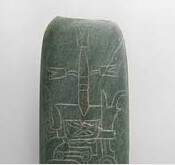
On the Gulf Coast, at the Olmec site of San Lorenzo, researchers announced a discovery that pushes back the timeline for complex ritual in the region. They uncovered a meticulously arranged offering of jade celts and figures, accompanied by distinctively carved magnetite mirrors, placed in a patterned floor dating to approximately 1200 BC. This find, detailed in Proceedings of the National Academy of Sciences, provides the earliest firm evidence for the use of magnetite, a naturally magnetic iron ore, in ritual contexts in the Americas, highlighting the Olmecs’ sophisticated knowledge of rare materials and their symbolic properties.
New Insights Into Zapotec Astronomy
Further south, in the Zapotec region of Oaxaca, archaeologists mapping the outskirts of Monte Albán used drone photography to identify a series of subtle stone alignments on a remote hillside. Excavation revealed a complex astronomical observatory, consisting of aligned sighting stones and a small temple platform.
One Of the Oldest Mesoamerican Ballcourts Uncovered in Honduras
In Honduras, continued research at the pre-Columbian site of Los Naranjos in the Lake Yojoa region yielded a significant discovery: the oldest known ballcourt in the Maya region, dating to around 800 BC. This Early Preclassic court is simpler in form than the later iconic versions but features the defining parallel structures. Its existence confirms that the ritual ballgame, a cornerstone of Mesoamerican ideology and politics, was established and widespread centuries earlier than the archaeological record previously demonstrated.
 Cobá’s Nohoch Mul Reopens To Visitors
In 2025, INAH installed a new wooden stairway to conserve Cobá’s largest structure while still allowing visitors to climb the ancient temple known as the Nohoch Mul. Known as Nohoch Mul, the 42-meter (140-foot) step pyramid is among the tallest in Quintana Roo and one of the few climbable structures of its size near the Riviera Maya. The word Nohoch Mul literally means “large pyramid” in Yucatec-Maya, but the structure’s original name has been lost to time.
 Carlos Rosado van der Gracht Journalist, photographer, and expedition leader. Born in Mérida, Carlos holds degrees from universities in Mexico, Canada, and Norway. https://yucatanmagazine.com/mesoamericas-10-archaeological-discoveries-in-2025/
Leave a Reply