
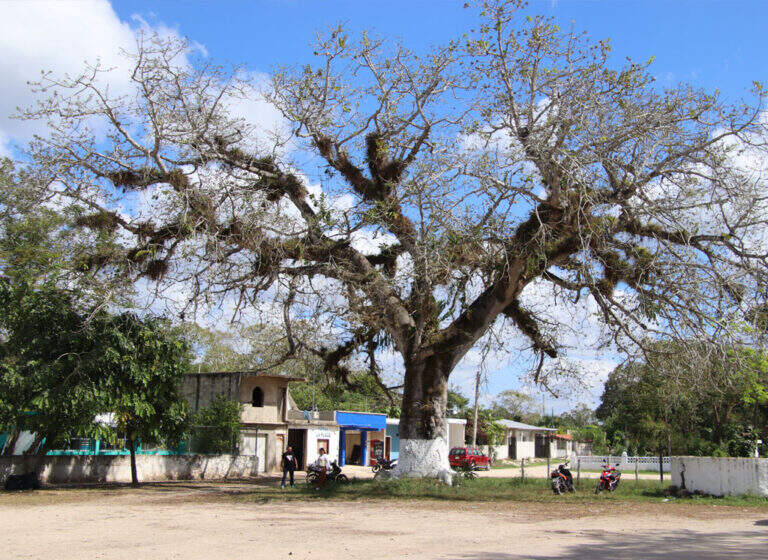
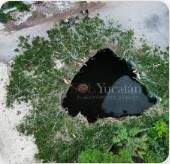
Today, most of the remains of the collapsed ceiba have been removed, leaving a cavernous cenote in what was once one of the town’s main streets. The cenote is off-limits because its stability is still unknown. While there has been some talk of conducting research and potentially even opening it up to visitors, at least for now, the sense of dread it causes among locals has been enough to put a stop to these ideas.
Xocén’s Church
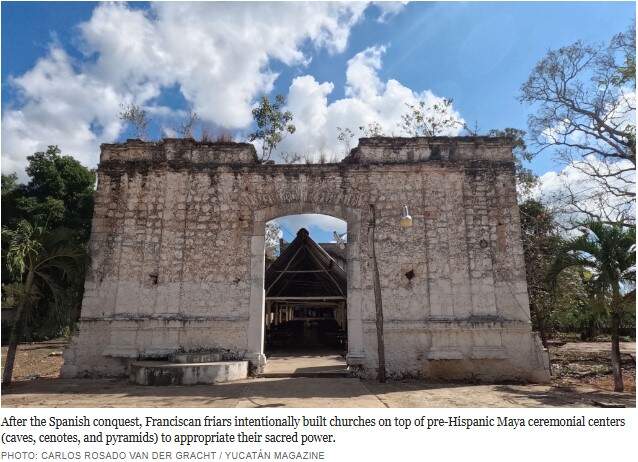
The town’s main church stands as a powerful testament to this layered history. The Church of San Juan Bautista, built in the 1500s, rises from a commanding base. Spanish colonizers constructed it directly atop the platform of a large Maya pyramid. The church’s foundation visibly incorporates the cut stones of that pre-Hispanic temple. The structure physically embodies the convergence of two worlds at this very spot—the ancient Maya civilization and the forces that followed.
 Though the colonial ceiling of the church collapsed long ago, locals have installed several makeshift iterations to protect its relics and congregation from the rain, the most recent being made of tin. At the altar sit several depictions of the Virgin Mary, a black Christ, and several saints. Locals deposit small notes of paper with prayers or petitions (mainly to the Virgin) and light candles as a representation of their oaths.
Another noteworthy feature of its church is its stations of the cross, which, though lacking the image of Christ, are painted green. The color is essential. In the Maya tradition, green represents the sacred center of the world, the four cardinal directions, and the precious life that comes from rain, corn, and the forest, and is again associated with the ceiba, both literally and cosmologically.
Though the church itself is very active, it also feels like a ruin, with only a few sections of its original architecture left intact. This juxtaposition only reinforces the already powerful sense of religious syncretism in this house of worship and deepens its mystique.
Preserving a Way of Life
 In present-day Xocén, the community maintains the ways of its ancestors. The Yucatec Maya language is spoken daily. The people work the land, cultivating corn in the traditional milpa system as has been done for millennia. For them, Xocén transcends geography. It represents the living heart of their culture and identity, the place where, according to the oldest stories, their world began.
Despite its proximity to Valladolid, the town is not a tourist attraction. While respect and consideration should be paid when visiting any community, this is particularly true in Xocén.

Leave a Reply