
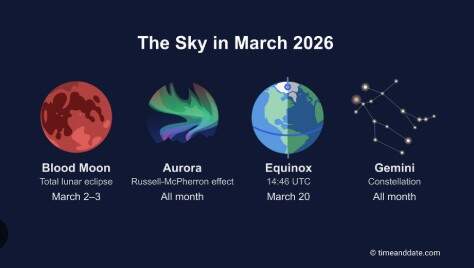
March 3 — Total Lunar Eclipse
A total lunar eclipse occurs when the moon passes through Earth’s shadow, turning blood red. The eclipse will be visible throughout North America. Totality begins at 3:04 a.m. and ends at 4:02 a.m. The greatest eclipse occurs at 3:33 a.m. Look to the southwest for this spectacle. An inconvenient time, but worth viewing and photographing if possible.
 March 20 — March Equinox
The March equinox occurs at 2:01 a.m. On this date, the sun will shine directly on the equator, and there will be nearly equal amounts of day and night throughout the world. It’s also the first day of spring (vernal/spring equinox) in the Northern Hemisphere and the first day of fall (autumnal Equinox) in the Southern Hemisphere.
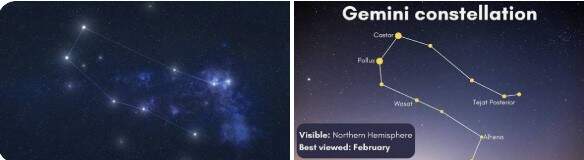 Gemini — all month
The Gemini constellation looks like two bright, parallel, stick-figure-like, or human-shaped figures standing side-by-side, representing the mythological twins Castor and Pollux. It’s easily recognized in the winter sky by its two brightest stars Castor and Pollux, which represent the heads of the twins.
Leave a Reply