
 When we think of Mexican birthday parties, we know that a piñata will be the focal point.
However, the tradition of the piñata started over 700 years ago in China! Marco Polo is often credited with bringing knowledge of this custom to Europe towards the end of the 13th century. In Italy, the piñata took the form of a fragile clay pot, called pignatta, which became part of ceremonies during Lent, particularly on the first Sunday, known as Pinata Sunday. The piñata traveled all over Europe and was later adopted by Mexico. It started out as a symbolic religious tool, then morphed into a fun cultural tradition.
 Long before the European influence, indigenous Mesoamerican peoples such as the Aztecs and Mayas had similar traditions. The Aztecs celebrated the birthday of Huitzilopochtli, the god of war and sun, with decorated clay pots filled with treasure, which were broken as part of ceremonial offerings. The Mayas also played games, where blindfolded participants struck suspended clay pots. These customs emphasized ritual and symbolism and were later harmonized with Christian teaching by the Spanish missionaries.
The piñata became formalized in colonial Mexico in the late 16th century. In 1586, Augustinian friars in Acolman, near Teotihuacan, incorporated the piñata into Christmas celebrations called Las Posadas to teach Christian principles.
The traditional design was a seven-pointed star, where each point represented one of the seven deadly sins. The blindfold represented faith, the stick symbolized virtue, and the candies inside represented the rewards of Heaven for overcoming sin. Over time, the religious significance diminished, and piñatas became central targets of fun activities at children’s birthday parties, school events, and community festivals.
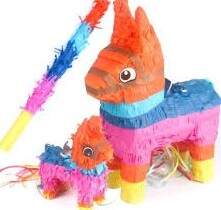 Today, piñatas are crafted from paper mâché, cardboard, and some clay, in diverse shapes ranging from traditional seven-point stars to animals, superheroes, or popular cartoon figures. The ritual of blindfolding and spinning participants while they strike the piñata remains a central feature, with songs sung to accompany the activity.
Piñatas are enjoyed during Las Posadas, Christmas celebrations, birthdays, and increasingly at secular events worldwide, while still maintaining connections to Mexican culture and communal spirt.
The piñata is a remarkable example of cultural adaptation and syncretism, evolving from a Chinese ritual tool to a European Easter and Lentan custom, through Mesoamerican traditions and final into the iconic, playful Mexican piñata cherished around the world.
Leave a Reply