The Maya Arch: Imagination, Artistry, Function

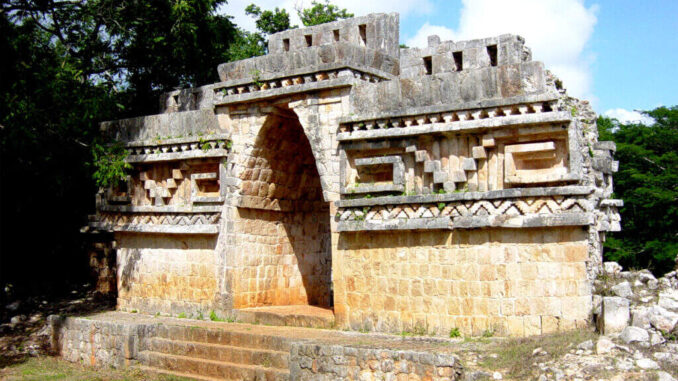
The Great Arch at Labná is considered one of the finest examples of this architectural form, so common in the Maya world.

One of the most immediately identifiable features of Maya architecture is the corbel arch.

Corbel arches are not exclusive to the Maya or even to Mesoamerica; they can also be found in regions such as Southeast Asia and the Hellenistic world. But without a doubt, it was the Maya who pushed this architectural form to its limits.

At its core, a corbel arch is formed by stacking stones, with each layer projecting slightly beyond the one below until the two sides meet at the top. While this technique naturally creates a triangular shape, the effect can be masked by using smaller bricks or by incorporating the arch into a larger oval structure.

The Maya used corbel construction for several purposes. They used it to support the heavy stone ceilings of interior temple chambers and passageways, and in the Puuc region of the Yucatán Peninsula, to build suspended stairways that were easy to walk beneath.
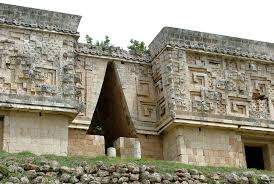
Over time, the corbel arch evolved into a more elaborate structural solution. In some cases, as with the massive arches on the Governor’s Temple of Uxmal, they appear to have been built for purely aesthetic purposes.
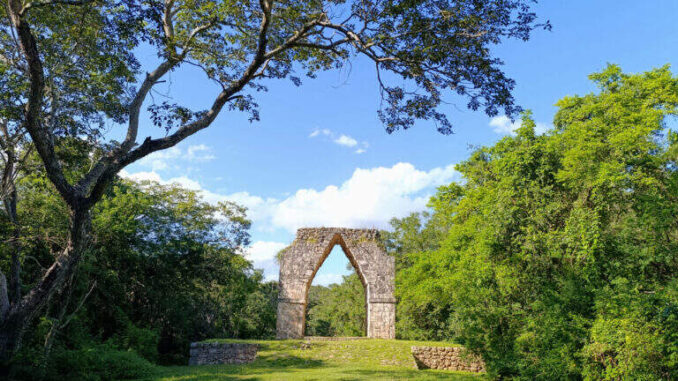
Perhaps the most fascinating role of the Maya corbel arch was its function as a gateway, both in a literal and metaphorical sense. It delineated sacred or restricted areas within and between cities and, in some instances, was likely used as a designated checkpoint for incoming merchants and travelers.

Kabah

The symbolic meaning of Maya corbel arches as literal and symbolic thresholds is most easily identifiable when we consider just how much effort went into building them, especially when they are essentially standalone structures at the beginning or end of a Sacbé (Mayan road)

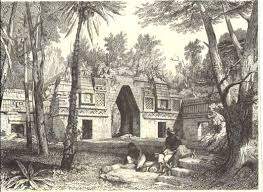
The Great Arch of Labná

The quintessential example of this is the famous arch at Labná, which served as a point of departure to and from the city on the way to other cities, including the regional capital of Uxmal.

During the 19th century, the renowned explorers John Lloyd Stephens and Frederick Catherwood were the first to document the Great Arch of Labná scientifically. Stephens described the arch as “One of the most beautiful and noble structures I have ever laid eyes on, standing apart from the other ruins in the already impressive site.” But it was Catherwood, the artist of the two, who famously produced an incredibly accurate and inspired rendering of the arch, which is known to anyone with even a passing interest in Maya architecture.
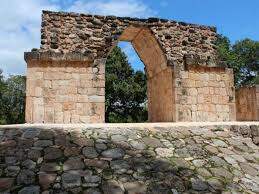
The entire facade of the arch is densely covered in a mosaic of cut stone. This decoration is organized in a series of horizontal registers and framed panels. The lower section of the facade features a plain, sloping molding. The upper facade is more elaborate, featuring a repeated lattice pattern, which may represent a thatched hut, framed by robust, curved moldings.

On the eastern side, a niche on the upper facade contains the remains of a carved seated figure. The decoration is geometric and repetitive, creating a textured surface without figurative narrative scenes. The structure is built entirely of precisely shaped limestone blocks, without mortar. Within its niches, remnants of pigment still survive, especially red. The arch is also situated at the edge of an artificial platform and then slopes downwards toward the

Oxkintok

Sacbé, denoting its role as a threshold.

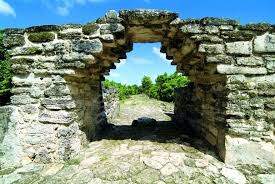
San Gervasio

While impressive, the arch of Labná is far from unique, as similar threshold arches exist at sites such as Oxkintok and San Gervasio. However, what makes the arch at Labná is perhaps the happy accident that the site was not looted to such an extent that it could not be “nearly” fully restored, something that can’t be said for the vast majority of its counterparts.

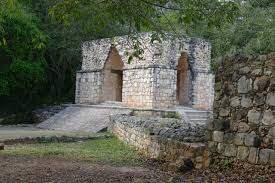
The Unorthodox Design of Ek Balam’s Arched Gateway

The builders behind the arch at Ek Balam, while likely aiming for a similar function, took their plans in an entirely different direction. In this case, while the arch retains its corbel features at its core, it appears more like a temple than an arch. The arch in question is built upon an artificial platform, with access points on all four sides — two of which are scalable through 10 stone steps each, while the other two feature sloped ramps at a similar angle to the stone staircases.
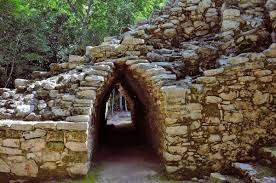
Although this arch may seem a standalone structure today, it was, actually part of an architectural complex that walled off the city’s core. But this wall was likely also symbolic/ceremonial, as it was not tall enough to effectively fend off invaders with modest ladders. This also makes further sense when we consider that the Maya practiced a form of warfare known as defense in depth, in which defense within a city was usually a last-ditch effort rather than a strategy.

Often, corbel arches also served to separate one part of a city from another. For example, the Serie Inicial (also known as Chichén Viejo) of Chichén Itzá features an impressive arch and ramp that connect to a perimeter wall, effectively cutting this part of the city and limiting access, as it was the only point of access or exit.

Though still tremendously impressive, it has only been partially restored, features a decidedly oval design, and was likely also domed, with a ceiling curve formed by intricately carved stones. It really is unlike anything else in the Maya world. Chichén Itzá is also home to several other standalone corbel arches, including a relatively recently restored example, which leads to the internal Sacbé number 74.

There are far too many impressive standalone corbel arches in the Yucatán alone to list and describe, and even more noteworthy implementations of this constructive technology.

Though sometimes described as a false arch, the corbel arch was used for form and function, and for an architectural tradition rich in meaning and symbolism that spans several ages. So get out there and explore!


Carlos Rosado van der Gracht — by Carlos Rosado van der Gracht  Senior Editor Carlos Rosado van der Gracht is a journalist, photographer and adventure leader. Born in Mérida, Carlos holds degrees from universities in Mexico, Canada, and Norway.      https://yucatanmagazine.com/maya-arch-corbel/

Be the first to comment

Leave a Reply

Your email address will not be published.


*