
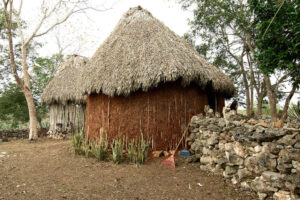
In the Yucatán Peninsula stands an architectural form that has remained unchanged for over 3,000 years. The traditional Maya house — known as xa’anil naj in the Mayan language — represents what Dr. Aurelio Sánchez of the Autonomous University of Yucatán calls “the only architecture in Mesoamerica that hasn’t needed to be modified for centuries. It’s a perfect creation of its kind.” This building tradition now faces multiple challenges that threaten its continuation.
Construction Based on Local Materials
 Huano demonstrates thermal efficiency by absorbing minimal heat even after prolonged sun exposure. While modern flat roofs retain heat radiation and increase reliance on air conditioning, huano naturally repels heat and provides insulation. Combined with bajareque walls — a traditional building technique using interwoven sticks and mud — and locally sourced woods, these homes achieve climate control without mechanical systems.
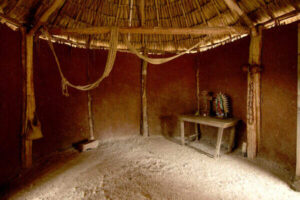
The Maya house functions as more than shelter. According to Maya cosmology, these homes serve as sacred spaces where the guardians of heaven, earth, and the underworld reside. Construction techniques are learned through practice and transmitted across generations through an established knowledge transfer system.
Current Challenges to Preservation
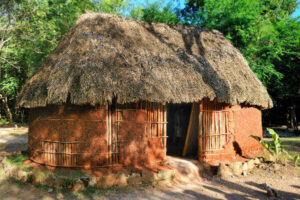
The traditional Maya house faces several interconnected challenges. The overexploitation of huano resources has increased as tourist resorts and developments adopt the material for its practical and aesthetic properties. This demand has made huano more scarce and expensive for traditional communities.
Urbanization acts against traditions. Young Maya people who move to cities for education and employment often do not learn the construction techniques that previous generations mastered.
“If we don’t continue tying houses together, new generations won’t learn how to do it, and that knowledge could be lost,” notes Dr. Sánchez. The specialized skills required to create hurricane-resistant structures risk disappearing as fewer people learn from experienced practitioners.
Legal restrictions and modern construction codes often do not accommodate traditional building methods, leading communities to abandon established techniques. Rising material costs due to shortages make traditional construction less accessible, while monoculture farming reduces the biodiversity that once provided diverse local building materials.
Preserving the Maya House
The Autonomous University of Yucatán collaborates with Maya communities to document and preserve this architectural tradition. The university has proposed including the traditional Maya house on UNESCO’s Indicative List of Intangible Cultural Heritage of Humanity. The corresponding documentation has been submitted to the National Institute of Anthropology and History (INAH).
Educational materials have been developed, including the 2018 documentary “Ichil xa’anil naj—In the House of Huano “ and a bilingual storytelling series designed to transmit knowledge to younger generations. These initiatives recognize that preserving Maya house construction involves maintaining what researchers describe as “the identity, memory, and ancestral knowledge of the Maya people.”
The traditional Maya house offers practical lessons for contemporary architecture. Its hurricane resistance, natural cooling properties, and use of biodegradable materials address current concerns about sustainable construction and climate adaptation. The continuation of this building tradition depends on maintaining both the material resources and the knowledge systems that have supported it for millennia.
The traditional Maya home relies primarily on huano, a palm species that grows throughout the Yucatán Peninsula. This plant reaches up to 40 feet in height with fan-like leaves that serve multiple construction purposes. Skilled craftsmen called palaperos dry and weave huano leaves into thatched roofs that provide natural cooling properties.

Leave a Reply