
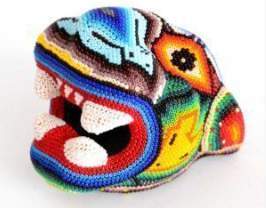
 The Huichol had established their roots in the states of Nayarit and Jalisco by the beginning of the Classic Mesoamerican period (200 to 700 AD). They consider themselves descendants of the black dog, tsuku mauyusauye, who helped them during the flood. The Huichol, also known as Wixárika, live mainly in the Sierra Madre Occidental. In their mythology, you can find elements from northern tribes (Teochichimecas) such as the peyote ritual; and elements of southern tribes as seen in their belief that the gods emerged from the sea. Huichol lore explains the origin of a structured existence: the sea, chaos and disorder are apparently pre-existent.
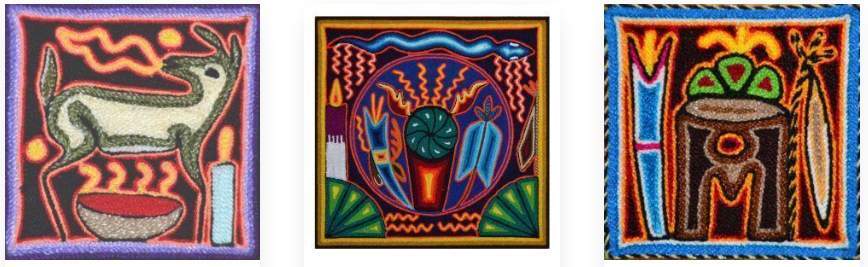
It is possible to consider the Huichol art as a form of writing, since through their creations, the Huicholes tell us their stories and myths, leaving a piece of their life in each work they make. Currently, it can be said that there is no other ethnic group in Mexico that preserves their beliefs, cults and traditions as deeply as the Huicholes.
Today there are 50,000 Huicholes. As an ethnic group they have managed to remain “pure” since the time of the Spanish conquest. When the Spanish invaded, the Huichol people fled to the mountains to preserve their autonomy. This independence allowed them to forge a culture with traditions and a very particular aesthetic.
Wixaritari philosophy is based on a universe divided by three entities: the deer, the corn and the peyote. Yarn is used to decorate the weaving of paintings, masks, and clothing, such as belts, belts or bags; and even, they are engraved in bowls and musical instruments. Additionally, when the Huicholes elaborate their ceremonial articles, they give much importance to the materials, colors and designs used, due to their sacred meaning related to the gods. For example, the wood of the Brazil tree is linked to Tayau or father sun, and the white flower of five petals is associated to the rains, good harvests and health. However, the most important motifs in the art of the Huichol culture are associated with deer and corn, as the primary source of food, and with peyote, as the link to the cosmogonic dimension.
Leave a Reply