
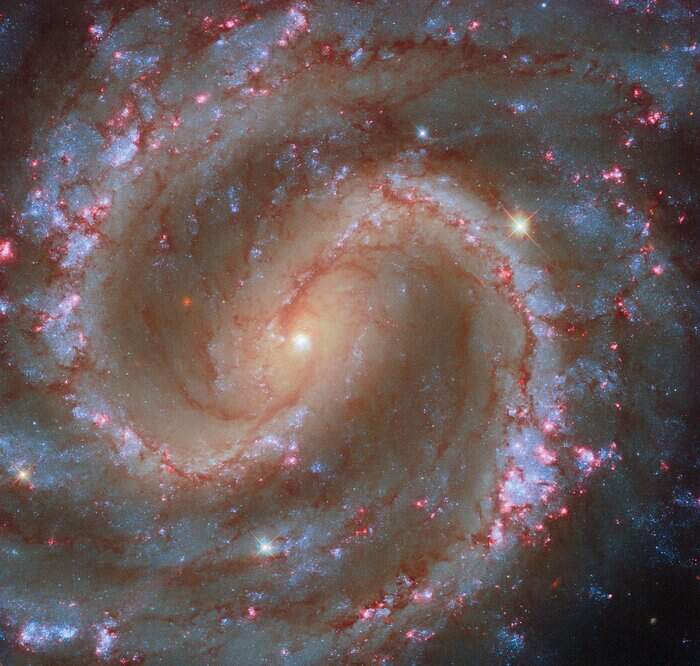
This ESA/Hubble Picture of the Week features the spiral galaxy NGC 4535, which is situated about 50 million light-years away in the constellation Virgo . This galaxy has been nicknamed the ‘Lost Galaxy’ because it’s extremely faint when viewed through a small telescope.
Image Description: A close-in view facing a spiral galaxy. Brightly lit spiral arms swing outwards through the galaxy’s disc, starting from an elliptical region in the centre. Thick strands of dark reddish dust are spread across the disc, mostly following the spiral arms. The arms also contain many glowing pink-red spots where stars form. The galaxy is a bit fainter beyond the arms, but speckled with blue stars. Is this cool or what!?
Photo Credit: ESA/Hubble & NASA, F. Belfiore, J. Lee and the PHANGS-HST Team. https://share.google/9NaNvThdnIpGIHulk
 Geminid Meteor Shower: This is the highlight of the month, with peak activity expected on the night of December 13-14. The waning crescent moon will rise several hours after midnight, providing dark skies for much of the night. Under ideal conditions, you could see up to 120 meteors per hour. The bright planet Jupiter will be a prominent feature in the sky near the Geminid radiant point during the peak of the shower.
Orion, Ursa Major, and Cassiopeia, along with the North Star (Polaris), are all visible from the Caribbean, similar to North America or Europe
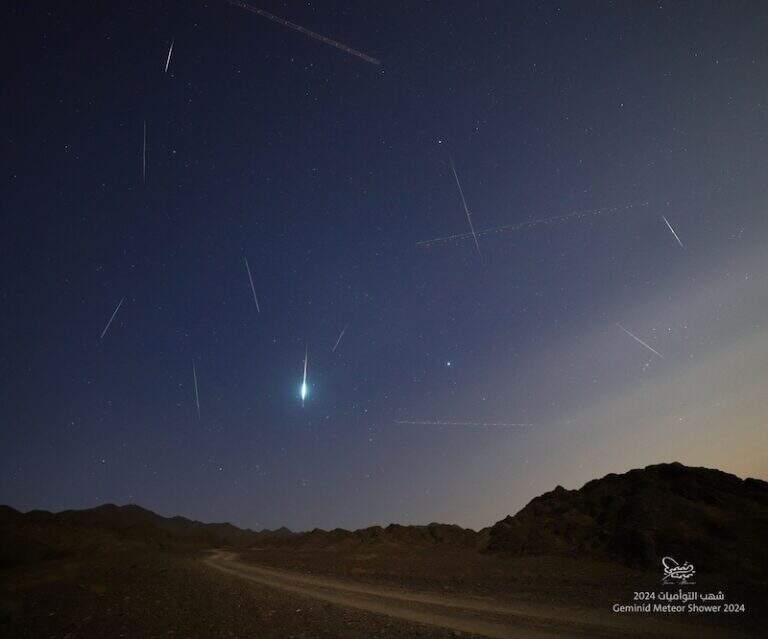
EarthSky Community Photos. | Tameem Altameemi of United Arab Emirates submitted this photo on December 14, 2024, and wrote: “Me and my brother decided to go to an area away from light pollution between the mountains in UAE, and despite the moonlight that filled the place, we were able to see and photograph many meteors and fireballs.
Leave a Reply